
Introduction
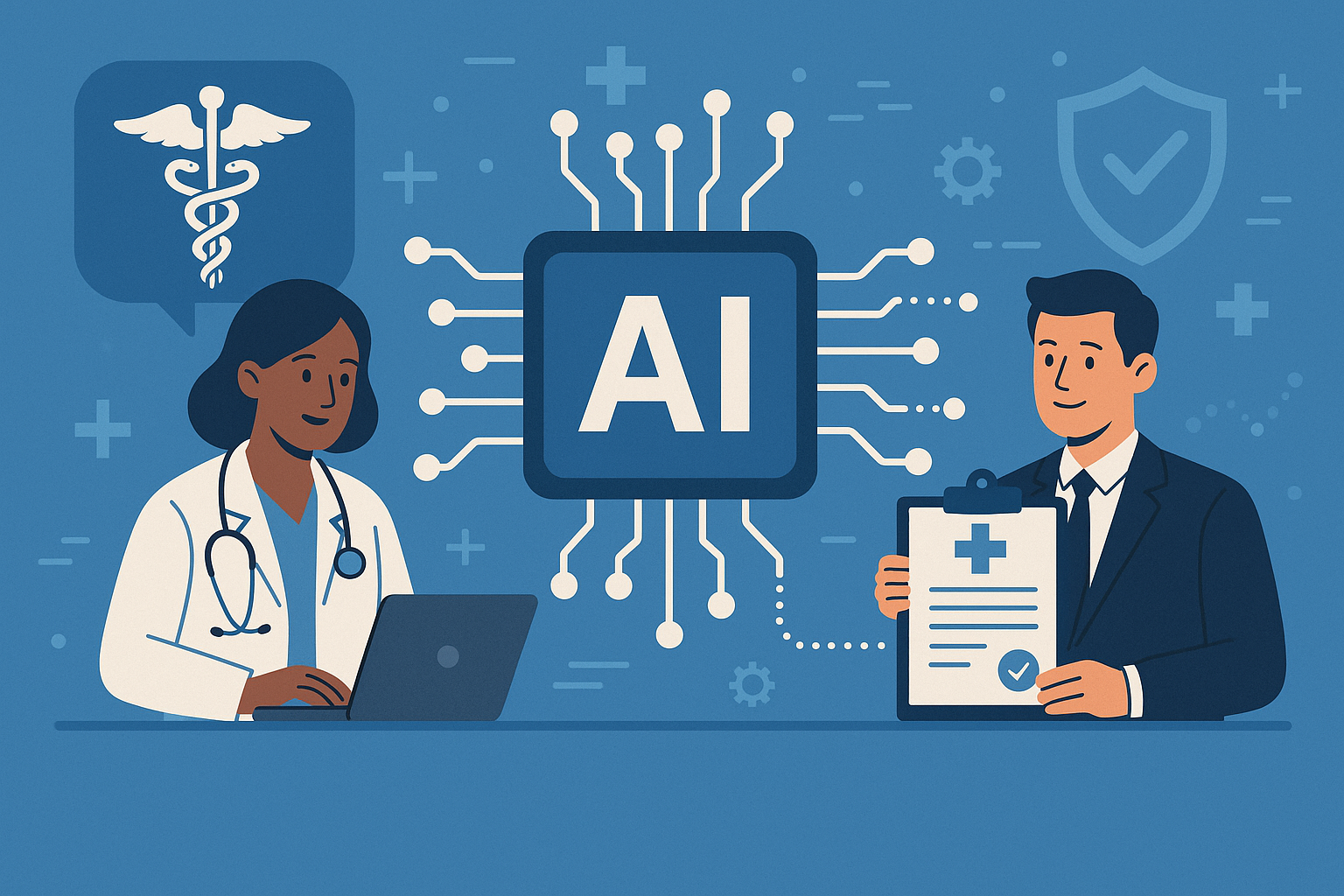
Artificial intelligence (AI) is no longer a futuristic concept in health insurance – it’s here now, reshaping how insurers operate and how employers’ health plans function. In fact, as of mid-2025, 84% of health insurers report using AI or machine learning in some capacity across their products (including group health plans). AI-driven algorithms are working behind the scenes to speed up routine processes and extract insights from massive healthcare data. For business owners who offer group health benefits, these developments have practical implications for plan efficiency, cost, and employee experience.
Key areas where AI is making an impact in health insurance today include:
- Claims Processing & Prior Authorization – automating approvals/denials and accelerating claim payouts.
- Fraud Detection & Cost Control – spotting fraudulent claims or billing patterns to save money.
- Customer Service & Member Engagement – using virtual assistants and personalized tools to improve service for employees.
- Plan Design & Risk Assessment – analyzing data for better underwriting, plan customization, and preventive care strategies.
In this article, we’ll explore each of these angles with real-world examples from 2025, and highlight how they affect employers and their health plan offerings.
AI Streamlining Claims Processing and Approvals
One of AI’s most impactful roles is in claims processing – the heart of any health insurance plan. Insurers have long used software to automatically process straightforward claims, but AI takes it further with machine learning and predictive algorithms. The result is faster decisions on claims and prior authorizations, often with minimal human intervention. For plan members (your employees), this can mean quicker reimbursements and fewer administrative hurdles.
- Lightning-Fast Decisions: AI algorithms can review claims data and medical records almost instantaneously. In fact, lawsuits against major insurers allege that algorithms have been used to deny or approve claims in mere seconds – one case claims an insurer processed each claim in about 1.2 seconds using AI. This speed dramatically reduces the waiting time for decisions compared to manual reviews that might take days. On the positive side, such tools can handle routine approvals swiftly, ensuring employees get timely care or payment. However, the ultra-fast denials have drawn scrutiny, underscoring the need for balance and oversight.
- Automating Prior Authorizations: Prior authorization (pre-approval for certain treatments or medications) has historically been a pain point, causing delays and frustration. AI is now being applied to automate these decisions in line with policy rules. Properly used, AI can even help approve requests more quickly by ensuring all forms and codes are in order for review. This can significantly cut down the back-and-forth between providers, insurers, and your HR team. (Regulators are watching this space closely to prevent inappropriate denials by “robot” reviewers, but responsible use of AI aims to streamline approvals, not create barriers.)
- Reducing Errors and Manual Work: Machine learning models excel at pattern recognition – they can cross-check claim details with coverage rules and past similar claims to catch inconsistencies or errors. This reduces human coding mistakes and can flag incomplete claims for correction rather than outright denial. For employers, fewer errors mean less time spent sorting out claim disputes for your employees. According to industry experts, the average insurance underwriting or claim decision that once took days can now be done in minutes by AI with over 99% accuracy in risk assessment. That kind of efficiency not only lowers administrative costs but also translates to a smoother experience for insured members.
It’s worth noting that alongside these efficiency gains, there’s growing attention to AI ethics and compliance. Regulators in many states have issued guidance to ensure AI-driven underwriting or claims decisions do not unfairly discriminate or violate insurance laws. As a business owner, you can take some comfort that consumer protection watchdogs are engaged here. The bottom line is that AI-powered claims processing – done right – should result in faster, more accurate handling of your employees’ medical claims and fewer headaches for all parties.
Fraud Detection and Cost Control with AI
Health insurance fraud – from bogus claims to billing for unperformed services – costs the industry tens of billions annually, which ultimately drives up premiums. AI is becoming a game changer in the fight against fraud, waste, and abuse. By analyzing patterns across vast datasets, AI systems can detect anomalies far more effectively than traditional methods, protecting both insurers and employers from unnecessary costs.
- Spotting Hidden Patterns: Traditional fraud detection relied on a list of rules or red flags (for example, a provider billing the same procedure too frequently). But fraud schemes constantly evolve, and rule-based systems can miss novel tricks. AI can continuously scan millions of data points to recognize unusual patterns or outliers that humans might overlook. For instance, intelligent algorithms now flag things like improbable patient journeys through providers, suspiciously identical medical documents (possibly deepfakes), or collusive networks of providers and patients. This “detective work” happens in real time, often stopping fraudulent claims before payment.
- Big Savings and Better Accuracy: The payoff from AI-driven fraud prevention is significant. McKinsey analysts estimate that for a large insurer, current AI tools could save $380–$970 million in claim payouts per $10 billion in revenue by catching more fraud and errors. Early adopters of AI report 60%+ increases in fraud detection rates while halving false alarms that wrongly tagged honest claims. Similarly, the U.S. Medicare program, which processes 4.5 million claims a day, deployed AI models that now identify over $1 billion in suspicious claims each year with 90%+ accuracy. These examples show how AI can drastically reduce losses. For employers, better fraud detection by insurers helps keep premiums and renewals more stable than they’d otherwise be – savings from prevented fraud can offset some of the ever-rising healthcare costs.
- Faster Investigations: Not only can AI catch bad claims, it also speeds up the investigation process. Machine learning systems prioritize the most suspicious cases for human investigators and even provide a rationale (e.g. pointing out a forged document or an improbable billing code combination). This means fraud units at insurance companies become more efficient, focusing their time where it really matters. Over time, as AI “learns” from confirmed fraud cases, it gets even better at recognizing emerging schemes. (Of course, fraudsters don’t sit still – there’s a cat-and-mouse element, especially now that criminals can use generative AI to create fake medical records or invoices. Insurers acknowledge they must “fight fire with fire,” using AI to spot AI-generated fakes in claims. It’s an arms race, but one where advanced analytics give the good guys an edge.)
For employers sponsoring health plans, robust fraud detection is largely invisible but crucial. It means less leakage of funds on false claims, which helps restrain premium inflation and protects your claims experience (for self-insured plans). Going forward, we can expect AI to be standard equipment in every insurer’s anti-fraud toolbox, from catching duplicate claims to flagging providers engaged in upcoding or phantom billing. A more secure plan is a more affordable plan.
Enhancing Customer Service and Member Experience
Another area where AI is making a very visible impact is in customer service for health plan members. Insurance can be confusing – employees often have questions about their coverage, claims, or finding care. AI-powered virtual assistants and chatbots are helping carriers provide faster, around-the-clock service, while new personalization tools guide members to better choices. This not only improves the employee experience but can also reduce the workload on HR teams and call centers.
Cigna’s myCigna app now integrates AI features such as a virtual assistant and personalized provider matching (see left screen), along with digital ID cards (right screen). The generative AI–powered assistant provides clear, conversational answers to common questions about coverage, claims, or finding care, and can seamlessly hand off to a human advocate if needed. The app also uses algorithms to suggest in-network doctors tailored to a member’s specific needs and preferences, and lets members track deductibles or submit claims simply by snapping a photo of a bill.
- 24/7 Virtual Help Desks: Many insurers in 2025 have rolled out AI-driven chatbots or voice assistants on their portals and apps. Unlike a traditional customer service line, these virtual agents are available 24/7 and can instantly answer routine questions: “Is my specialist visit covered?” “What’s my deductible balance?” “How do I find a cardiologist in-network?” Because they’re powered by natural language processing, they understand questions phrased in plain English and can pull the relevant information for the member. For example, Cigna Healthcare recently introduced a generative AI virtual assistant that gives personalized, easy-to-understand answers on benefits, claims, and care options. During a pilot, two-thirds of customers used this tool proactively, and over 80% found it helpful – showing strong adoption and satisfaction. For employers, this means your employees can get answers anytime without always needing to involve HR or endure long call center hold times.
- Personalized Guidance: AI is also helping create a more tailored healthcare experience. One new feature we’re seeing is AI-powered provider matching, where an insurer’s app can recommend doctors or clinics based on a patient’s specific health needs, location, and even preferences. Cigna’s tool, for instance, suggests a “Best Match” provider by analyzing factors like quality, cost, and patient reviews. Other insurers use AI to predict which members might need extra support – for example, identifying someone with a new chronic condition and proactively offering care management or nurse coaching. This kind of personalization can lead to better health outcomes and less wasted spend (by steering patients to high-quality, cost-effective providers). It’s essentially bringing a concierge-like experience to regular health plans, which can boost employee confidence in using their benefits.
- Streamlined Enrollment and Benefits Education: From the employer’s side, AI tools are emerging to simplify how benefits information is delivered to employees. A great example is the platform Nayya, which integrates AI into the benefits enrollment and education process. In 2025, Nayya launched a tool that uses AI to convert the heaps of HR benefits paperwork into interactive, digital resources. It auto-generates employer-branded microsites and searchable documents that make it far easier for employees to understand their health plan options and details. Early adopters saw a 40% reduction in open enrollment prep time for HR teams by using this AI-driven content platform. Importantly, because employees can actually find and comprehend their benefits information year-round (instead of digging through PDFs or calling HR), they tend to utilize their benefits better. That means better value for the money you’re investing in those benefits. We’ve all heard that many employees don’t fully grasp their insurance – AI is helping bridge this “benefits literacy” gap by presenting information in more intuitive ways.
- Cost Savings and Efficiency: From the insurer perspective, AI customer service isn’t just about flashy new apps – it also drives efficiency. One international health insurer reported saving $22 million by using AI-driven digital assistants, cutting customer service costs by 60%. Those savings can indirectly benefit employers if they help hold down administrative fees or premiums. Even for your own operations, having smarter self-service tools could mean fewer calls to your HR department about coverage basics, freeing your team to focus on higher-level tasks.
In short, AI is enabling a more user-friendly insurance experience. Employees today expect convenience and instant answers (just like they get in retail or banking), and insurers are finally catching up by deploying these AI solutions. Business owners should view these as value-adds: a smoother insurance experience can lead to happier, healthier employees with less time lost to confusion or administrative issues.
AI in Plan Design, Underwriting, and Risk Management
Designing and pricing a health plan involves complex trade-offs: setting premiums, coverage levels, managing network quality, and anticipating healthcare utilization. AI and advanced analytics are empowering insurers – and large self-funded employers – to make smarter decisions in plan design and risk management. In 2025, we’re seeing AI help with everything from tailoring plan offerings to predicting health risks in a population, which ultimately affects the options and rates employers receive.
- Smarter Underwriting and Pricing: In the small group and individual insurance markets, AI-driven underwriting is speeding up the quote and pricing process. By crunching vast data (demographics, medical histories, pharmacy usage, etc.), machine learning models can more accurately assess risk and set premiums for a given group. They detect patterns that manual underwriters might miss and update pricing assumptions in real time. This can mean fairer rates – low-risk groups not overpaying, and higher-risk groups’ premiums reflecting early warning flags that allow interventions. One study found that AI reduced typical insurance underwriting time from multiple days down to about 12 minutes, while maintaining 99% accuracy in risk assessment. For an employer shopping for coverage, that could translate to a quicker turnaround on quotes and potentially more competitive pricing if the insurer’s AI finds your workforce has better health metrics than initially apparent. (On the flip side, highly sophisticated risk models might also identify concerns that raise premiums – but at least those would be based on real predictive factors rather than crude broad-brush ratings.)
- Customized Plan Design: Insurers are also leveraging AI to optimize plan designs and coverage policies. Generative AI, for example, can ingest and analyze the textual content of hundreds of plan documents, policy manuals, and clinical guidelines across the industry. Consulting firm Oliver Wyman describes using AI to benchmark a health plan’s policies against competitors – identifying where, say, your plan’s prior authorization rules are stricter than others, or where adding a benefit could improve member satisfaction without huge cost. This kind of analysis helps insurers (and large employers with custom plans) fine-tune plan features. In practice, it might lead to introducing a popular new benefit, relaxing an overly tight coverage rule to improve employee experience, or tightening something that most of the market is managing more aggressively. The end goal is a plan that is both competitive and aligned with market best practices, which benefits employers through better value and happier enrollees.
- Population Health Management: For group health plans, a key aspect of risk management is understanding and managing the health of your employee population. AI is supercharging the analytics in this area. Insurers now use predictive models to identify “rising risk” individuals – employees who aren’t high-cost claimants yet, but likely will be due to emerging health issues. For example, AI can flag an employee with early signs of diabetes or hypertension and prompt a wellness or care management program referral before that person ends up in the ER or on costly medications. Some insurers have AI models specifically focused on things like medication adherence risk – predicting who is likely not taking their medications properly, so care managers can intervene. By catching these gaps, insurers aim to prevent expensive complications, which in turn keeps the group’s overall costs down. Employers offering plans benefit through potentially lower claims cost trends and healthier employees. In essence, AI lets health plans move from a reactive stance (paying claims after someone gets sick) to a proactive one (preventing or mitigating the sickness in the first place).
- Dynamic Risk Assessment and Wellness Programs: We’re also seeing the integration of IoT and wearable data into underwriting and plan management. AI systems can incorporate data from fitness trackers, health apps, or routine screenings to refine risk profiles. Insurers are piloting programs where, for example, employees who opt in to share their wearable fitness data might get personalized wellness recommendations or even adjustments on premiums. Over time, this creates a feedback loop: continuous data helps AI models predict health events more accurately, which can inform everything from setting stop-loss insurance levels for self-funded employers to deciding which wellness initiatives yield the best ROI. While still early, the trend is toward more personalized health plans driven by AI insights – one analysis suggests that personalized, AI-informed health plans could lower medical costs by around 10% through better prevention and care optimization.
- Managing Cost of Care and Provider Value: Beyond the member level, AI helps analyze cost and quality data across providers and treatments. New analytic solutions (like SAS’s Health Cost of Care Analytics, launched in 2025) assemble claims into “episodes of care” and evaluate which providers or care pathways deliver the best value. Using AI, an insurer (or a large self-funded employer’s consultant) can determine, for example, the cost differences between two hospitals for a knee surgery and the outcomes achieved. These insights support plan design decisions such as creating tiered networks or centers of excellence for certain procedures. They also feed into alternative payment models – AI can assist in setting more precise reimbursement rates or performance bonuses by comparing providers on apples-to-apples quality metrics, adjusted for patient risk. For employers, this means your insurance partners are getting better at steering members to high-quality, cost-efficient care – a trend that can bend your cost curve in the right direction while maintaining or improving care quality.
Overall, AI in plan design and risk management is about using data-driven intelligence to make health benefits more effective and cost-efficient. The technology works largely behind the scenes, but its influence emerges in the plan options and premiums you negotiate, and in the programs your insurer offers to keep your workforce healthy. As a business leader, staying aware of these capabilities can help you ask the right questions of your insurance carriers or brokers (“How are you using AI to improve our plan and control costs?”) and ensure you’re taking advantage of the latest innovations in healthcare benefits.
Conclusion
AI’s role in the health insurance industry has grown dramatically by 2025 – it’s touching nearly every aspect of how plans are run and experienced. For business owners and HR leaders, the rise of AI in insurance offers several clear benefits: faster claims and fewer hassles for your employees, stronger fraud protection for your plan dollars, more convenient and personalized service, and data-driven plan management that can rein in costs. These advancements are not just theoretical; they are already in use or launching now, from major carriers deploying AI chat assistants to specialized firms rolling out AI analytics for plan optimization.
Of course, with any transformative technology, it’s wise to remain mindful of challenges. There are ongoing conversations about ensuring AI decisions are fair and transparent, about safeguarding sensitive health data, and about maintaining the human touch where it matters (for instance, compassion in customer service or clinical judgment in care decisions). Regulators are actively engaging on these issues, and insurers themselves are instituting governance frameworks – nearly 92% of health insurers say they have AI governance principles in place to uphold accountability and privacy. In short, the industry is aware that trust is paramount when AI is involved in healthcare.
For employers, the practical takeaway is to embrace the positive impacts of AI in your health benefits while keeping an eye on how your insurance partners use it. Leverage the tools made available – encourage your employees to use that new AI nurse chatbot or cost estimation tool, for example. These can demystify healthcare and cut down on delays. When reviewing plan performance or renewal proposals, ask your insurer how AI has helped improve outcomes or reduce waste for your group. The more you can align your company’s health strategy with these technological improvements, the more value you’ll get from your benefits investment.
In a landscape of rising medical costs and evolving workforce needs, AI is a powerful ally in making health insurance work smarter. It’s helping insurers detect problems and solve them before they hit your bottom line, and helping your employees navigate their health benefits with confidence. The companies that stay informed and engaged with these innovations will be best positioned to deliver quality, cost-effective healthcare coverage in the years ahead. As we’ve seen in 2025, the AI revolution in health insurance is well underway – and it’s turning what has traditionally been a headache-inducing experience into something more efficient, user-friendly, and adaptive for businesses and their employees alike.
Sources: Recent industry reports and news releases have informed this article, including the NAIC’s 2025 survey on AI in health insurance, press releases from health insurers and technology firms, and expert analyses on AI’s impact on claims, fraud, and underwriting. These illustrate the real-world applications of AI in claims processing, fraud detection, customer service, and plan optimization as of 2025.